
There is something about Mary Magdalene’s story that gets me every single time I read it.
She was not a queen. She was not someone with a perfect past. She was a woman who had been through something dark. Something that would have made most people write her off completely.
And yet Jesus didn’t.
He stopped for her. He healed her. He kept her close. And when the most important moment in all of human history finally arrived, He chose her. He chose her to be the first person to see Him alive again.
That is the kind of thing that makes you put the book down and just sit with it.
If you have ever felt like your past disqualifies you from being used by God, I want you to read this slowly. Because the story of Mary Magdalene in the Bible is really a story about what happens when grace meets a life that everyone else had already counted out.
Let’s walk through it together.
Who Was Mary Magdalene in the Bible?
Before we get into what she did, let’s talk about who she was.
Mary Magdalene’s name tells us something about where she came from. The word “Magdalene” most likely means she was from a town called Magdala. Magdala was a small town on the western side of the Sea of Galilee. It was a busy fishing town. Real people, real lives, real struggles.
She was not royalty. She was not a famous rabbi’s daughter. She was just a woman from a fishing town who had a life that had gone very wrong.
The Bible mentions her by name fourteen times. That is not a lot, but every single time she shows up, she is doing something meaningful. Something brave. Something that tells you a great deal about who she really was.
What Happened to Mary Magdalene Before She Met Jesus?
Here is where her story starts.
The Gospel of Luke tells us plainly that Mary Magdalene was a woman “from whom seven demons had come out” (Luke 8:2).
Seven demons.
We don’t know what that looked like in her daily life. We don’t know if it caused her physical pain, mental torment, or something in between. But we know it was serious. We know it was the kind of thing that would have made people cross to the other side of the street when they saw her coming.
She was not just a little bit troubled. She was deeply, heavily bound.
And that is exactly who Jesus healed.
He didn’t wait for her to get better on her own. He didn’t give her a list of things to do first. He just freed her. Completely.
One encounter with Jesus and everything changed.
What Did Seven Demons Actually Mean?
This is one of the things people wonder most when they read about Mary Magdalene. And it deserves a real answer.
In the Jewish world of the first century, the word “demon” was used to describe things we might call illness, affliction, or deep torment. It covered a wide range of experiences — things that were physical, mental, and spiritual. It wasn’t always what we see in scary movies today.
Some Bible scholars believe Mary had a serious physical condition that Jesus healed. Others believe it was a deep form of mental or emotional suffering. Some see it as genuine spiritual oppression. What most scholars agree on is this: it was not a sign of moral failure. It was a sign of serious suffering.
The number seven matters too. In Jewish culture, seven represented completeness or fullness. So to say she had seven demons was to say she was completely bound. Utterly afflicted. There was nothing left of a free life.
Bible scholar Richard Vinson put it plainly. He said the seven demons were “a sign of her misery, not her wickedness.”
That is the key sentence. She was not wicked. She was miserable. And Jesus came for the miserable ones.
Whatever it looked like in her daily life, it was enough to make her someone that people pitied or feared or avoided. And then she met Jesus. And He freed her from all of it. Not some of it. All of it. Completely.
That kind of healing creates a particular kind of loyalty. And Mary’s loyalty to Jesus would prove to be unlike anyone else’s.
Was Mary Magdalene a Prostitute?
This is a question a lot of people ask when they first hear her name. It’s important to be honest here.
No. The Bible never calls Mary Magdalene a prostitute.
That misunderstanding started many centuries ago when a church leader mixed up different women in the Gospels and placed them all under Mary Magdalene’s name. That mistake stuck for a long time. But the Bible itself is clear. It never once connects her to prostitution or sexual sin.
What the Bible does say is that she had seven demons cast out of her. That’s it. That’s all we know about her past.
So if you’ve heard the other story, you can set it down. It’s not in the Scripture.
How Many Marys Are in the Bible? Untangling the Confusion
Part of the reason Mary Magdalene got tangled up in this confusion is that there are several women named Mary in the New Testament. And they are genuinely different people.
Here is a simple way to tell them apart:
Mary, the mother of Jesus. This is the woman who carried Jesus and raised Him. She is at the cross. She is in the upper room. She is the most prominent Mary in the entire Bible.
Mary Magdalene. The woman we are talking about in this article. She was from Magdala, had seven demons cast out, followed Jesus, supported His ministry, and was the first to see Him after the resurrection.
Mary of Bethany. This is the sister of Martha and Lazarus. She is the one who sat at Jesus’ feet while Martha cooked (Luke 10:38-42). She is also the one who anointed Jesus with expensive perfume before His death (John 12:1-3). She is a beautiful figure, but she is a different person from Mary Magdalene.
Mary the mother of James. Mentioned at the crucifixion and resurrection, but not much else is said about her background.
Mary the wife of Clopas. She appears at the foot of the cross in John’s Gospel. Some believe she may be the same person as Mary the mother of James, but this is not certain.
These are distinct women. The mistake of merging them together — especially Mary Magdalene and Mary of Bethany — is what gave rise to centuries of false teaching about who Mary Magdalene was.
When you read the Gospels carefully and keep each Mary separate, Mary Magdalene’s story becomes much cleaner. She is the healed woman from Galilee who gave everything to follow Jesus. Nothing more and nothing less.
Mary Magdalene Becomes a Follower of Jesus
After Jesus healed her, something shifted inside her. She didn’t just go home and say “well that was nice.” She gave her whole life to following Him.
Luke 8:1-3 shows us a small group of women who traveled with Jesus and His twelve disciples. They helped fund the ministry out of their own resources. Mary Magdalene is listed first among them.
She was there for the teachings. She was there for the miracles. She watched how He treated people. She heard His words about the kingdom of God.
And she didn’t just sit in the back row. She gave. She served. She stayed close.
In a culture where women were rarely included in religious circles, Jesus welcomed her into the heart of what He was doing. That was not an accident. That was Jesus being exactly who He always is, someone who sees past what the world sees.
Mary Magdalene at the Cross
Now here is the part that I think reveals her character more than anything else.
When Jesus was arrested, most of His disciples scattered. The fear was real. Being associated with someone the government just arrested was dangerous.
But Mary Magdalene didn’t leave.
Matthew 27:55-56, Mark 15:40, and John 19:25 all place her at the crucifixion. She stood there and watched. She watched the man who had set her free suffer in the most brutal way imaginable.
She didn’t run. She didn’t hide her face. She stayed.
I think about that a lot. That kind of loyalty doesn’t come from nowhere. It comes from someone who knows what it felt like to be truly seen and loved. Someone who understands that the person hanging on that cross gave her life back to her.
She owed Him everything. And when it cost her something to stand there, she stood.
Mary Magdalene and the Burial of Jesus
After Jesus died, Joseph of Arimathea came to take His body and place it in a tomb.
Mary Magdalene was there for that too. Matthew 27:61 says that she and another woman sat across from the tomb and watched where He was laid to rest.
She memorized the place. She noted the path. She was going to come back.
That detail matters. She was already making plans to honor Him even in death. Even when hope felt completely gone, she was still present. Still faithful. Still doing the next thing love required of her.
Mary Magdalene at the Empty Tomb
Now we get to the part of the story that changes everything.
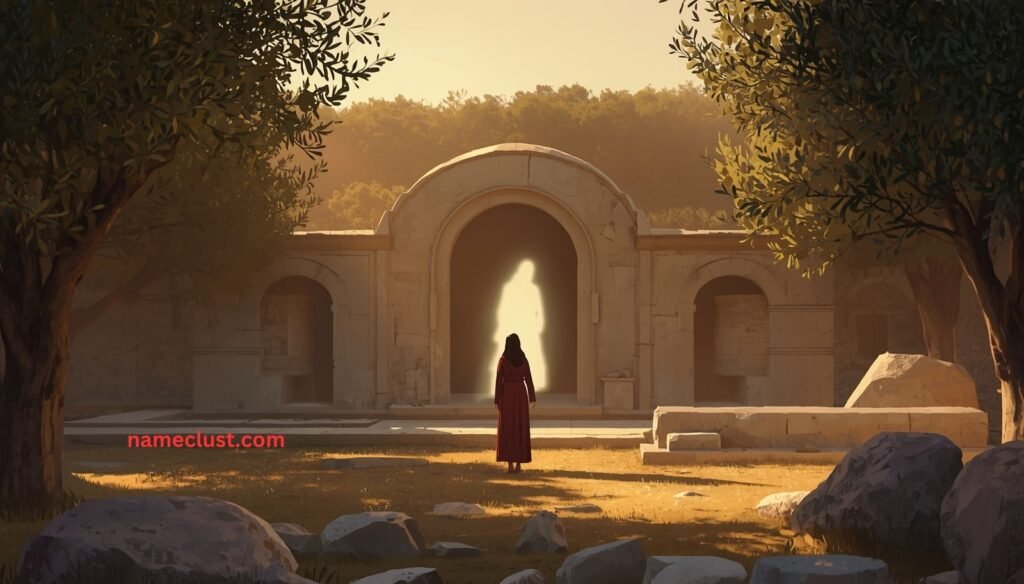
Early on the first day of the week, while it was still dark, Mary Magdalene went to the tomb (John 20:1). She went to grieve. She went to anoint His body and say a proper goodbye.
But when she arrived, the stone was rolled away. The tomb was empty.
She ran to tell Peter and John. They came, looked inside, and left. But Mary stayed.
She stood outside the tomb weeping (John 20:11). She was not going anywhere. Even now, even when nothing made sense, she stayed close to the place where He had been.
Then something happened.
She looked into the tomb and saw two angels. They asked her why she was crying. She told them. Then she turned around and saw a man standing near her. She thought He was the gardener.
She asked Him if He knew where the body had been taken.
And then He said her name.
“Mary.”
Just her name. One word. And she knew.
She turned and said “Rabboni!” — which means Teacher.
That moment. Right there. That is the heart of the whole story.
The risen Jesus, on the most important morning in history, spoke a woman’s name first. A woman who had seven demons. A woman the world had written off. A woman who had stayed when everyone else left.
He called her by name.
Mary Magdalene — The First Witness to the Resurrection
Jesus then gave her a job to do.
He told her to go and tell His brothers that He was rising to the Father (John 20:17). And she went. She ran to the disciples and said, “I have seen the Lord” (John 20:18).
The early church has long called her “Apostle to the Apostles” because of this moment. She carried the most important news the world had ever heard. And she carried it faithfully.
Think about what that means.
In that day, a woman’s testimony was not considered reliable in a court of law. Women were often overlooked in public life. And yet Jesus chose Mary Magdalene — a woman from a small fishing town, a woman who had suffered deeply, a woman others would have dismissed — to be the first person to announce His resurrection.
That was not a mistake. That was intentional. That was Jesus making a statement about who He values and who He trusts.
What “Apostle to the Apostles” Really Means
Because of that garden moment, Mary Magdalene has been given one of the most honoured titles in all of church history.
She is called Apostola Apostolorum — Apostle to the Apostles.
The word “apostle” comes from a Greek word that means “one who is sent.” An apostle is someone commissioned by God with a message to deliver. And Mary Magdalene was commissioned directly by the risen Jesus to deliver the most important message in history.
She was sent to the apostles. She was the apostle to the apostles.
This title was not invented recently. Early church fathers were using it centuries ago. Hippolytus of Rome, writing in the late second century, was among the first to honour her with it. Thomas Aquinas, the great theologian of the thirteenth century, also called her by this name. Saint Augustine praised her as someone who loved Jesus with more burning devotion than any of the other women who ministered to Him.
In 2016, Pope Francis made it official by elevating her feast day — July 22 — from a minor memorial to a full liturgical feast, placing her on the same level as the male apostles in the church calendar. The Vatican stated clearly that she was a “witness of Divine Mercy” and a model for every believer.
The Eastern Orthodox Church has always called her something even bigger — “Equal to the Apostles.” They never embraced the prostitute myth in the first place. They always honoured her as a devoted, faithful, courageous woman of God.
So when you hear the name Mary Magdalene, that is the full picture. Not a reformed sinner from the gutter. A commissioned messenger from the resurrected King.
What Happened to Mary Magdalene After the Resurrection?
The Bible goes quiet about her after this. We don’t have a full record of what the rest of her life looked like.
There are two strong traditions that have been passed down over centuries. One says she traveled to Ephesus with the mother of Jesus and the Apostle John, and she died and was buried there. The other tradition, especially strong in France, says she sailed there and spent her final years in prayer and solitude before she died.
We cannot say for certain which is true. But both traditions agree on one thing. She spent the rest of her life living in devotion to the same Jesus who had set her free.
She never stopped.
What We Can Learn from the Story of Mary Magdalene in the Bible
Her story carries real weight for anyone walking through hard things today.
Your past does not define your future. Mary came to Jesus with seven demons. She left as a faithful disciple. What happened before Jesus got involved did not determine what happened after. The same is true for you.
Loyalty in hard moments matters. She stayed at the cross when it was costly. Faithful love shows up when showing up is difficult. Her presence at the crucifixion was not a small thing. It was a choice.
God sees you, even when others don’t. In a world that overlooked women, Jesus consistently stopped, turned, and centered them. He saw Mary completely. He sees you completely too.
The broken ones are not disqualified. They are often the ones God calls first. Mary Magdalene was not chosen despite her suffering. Her story shows that God moves closest to those who have been through the most.
How to Use Mary Magdalene’s Story in Your Own Walk With God
Her story is not just something to read. It is something to carry.
When you feel like your past is too heavy, remember Mary Magdalene’s story in the Bible. Remember that Jesus didn’t wait for her to figure it all out before He healed her.
When you feel invisible or overlooked, remember that He called her by name in a garden on the most important morning in history.
When you feel like your voice or your testimony doesn’t matter, remember that He trusted her to carry the most important message anyone has ever been asked to carry.
Her life was not wasted. Her suffering was not the end of her story. And yours doesn’t have to be either.
Frequently Asked Questions About Mary Magdalene in the Bible
1. What does the story of Mary Magdalene in the Bible really teach us? Her story teaches us that no one is beyond healing, that faithful love stays when it costs something, and that God uses the people the world overlooks for the most important purposes.
2. Why did Jesus appear to Mary Magdalene first after the resurrection? The Bible doesn’t explain exactly why. But her consistent presence — at the cross, at the burial, and at the tomb before sunrise — reflects a love and commitment that was unshakeable. She was there, and Jesus met her there.
3. Was Mary Magdalene really a prostitute? No. The Bible never says this. This idea came from a misinterpretation that mixed up different women in the Gospels. The only thing the Bible says about her past is that she had seven demons cast out of her.
4. What does “Magdalene” mean in the Bible? It is widely understood to mean she came from a town called Magdala, a small fishing village on the western shore of the Sea of Galilee. It was not a last name but a way of identifying where she was from.
5. How many times is Mary Magdalene mentioned in the Bible? She is mentioned by name fourteen times across the four Gospels. Most of those appearances happen during the crucifixion, burial, and resurrection of Jesus.
6. What happened to Mary Magdalene after Jesus ascended to heaven? The Bible doesn’t give us a clear record of her life after the resurrection. Church traditions suggest she either traveled to Ephesus with the Apostle John and the mother of Jesus, or sailed to France, where she spent her remaining years in prayer and solitude. Both traditions agree she remained devoted to Jesus until the end of her life.
If Mary Magdalene’s story moved you today, share it with someone who needs to hear it. Bookmark this and come back to it when you need a reminder that no past is too dark for God’s grace.
Her story is proof. And it still speaks.