
Fear is not a modern invention. Every person in every story in this article was afraid — genuinely, physically, existentially afraid. David knew what a nine-foot soldier could do to a boy with a sling. Daniel knew what lions did to men. Esther knew what happened to people who entered the throne room uninvited.
Paul and Silas had felt the rod before the prison. Ruth knew what it meant to be a foreign widow in a land with no safety net. And in the garden of Gethsemane, Jesus sweat blood from the weight of what was coming.
What made these people remarkable was not that they were unafraid. It is that they acted anyway and more specifically, they acted from faith in a God who was bigger than whatever stood in front of them. That is the pattern woven through every one of these stories, and it is the pattern available to you today in whatever you are facing.
This is not a quick list. Each story here is told fully, with its Hebrew or Greek depth where it matters, with the specific kind of courage it demonstrates, because courage is not one thing. There is the courage of confrontation (David), the courage of persistence (Joshua), the courage of speaking up (Esther), the courage of faithfulness (Daniel), the courage of defiance (Shadrach, Meshach, and Abednego), the courage of stillness (Elijah), the courage of worship (Paul and Silas), the courage of loyalty (Ruth), and the courage of surrender (Gethsemane). Each one will meet a different need in a different reader. Find the one that speaks to where you are.
Before the Stories — What the Bible Actually Means by “Courage”
Three words that together paint the full picture of biblical strength
Notice what all three words imply: courage is not the absence of fear. Chazaq is about holding on, which implies something is trying to pull you loose. Amats is about alertness, which implies danger is present. Tharseō is a command to receive, which implies it must come from outside yourself. Biblical courage is always courage in the presence of fear, drawing from a source bigger than itself. These nine stories demonstrate exactly that.
For forty days, Goliath of Gath walked to the front of the Philistine battle line and issued the same challenge. He was a military champion — over nine feet tall by some textual accounts, armour weighing 125 pounds, carrying a spear whose iron head alone weighed fifteen pounds. For forty days, not one man in Israel’s army responded. Including the king.
Then David arrived. He had not been at the battlefield — he was a teenager, the youngest of Jesse’s sons, still tending sheep. He came to bring food to his brothers. And when he heard Goliath’s taunts, his response was not terror. It was outrage. “Who is this uncircumcised Philistine that he should defy the armies of the living God?” (1 Samuel 17:26).
The key to David’s courage is what he said to Goliath: “You come against me with sword and spear and javelin, but I come against you in the name of the Lord Almighty, the God of the armies of Israel” (1 Samuel 17:45). David was not braver than Saul or the soldiers. He was differently focused. Every other man in the camp was measuring themselves against Goliath. David was measuring Goliath against God — and the comparison looked very different from that angle.
He ran toward the giant. One stone. One sling. Goliath fell face-down. And one teenager’s God-confidence — built not on arrogance but on specific remembered experiences of God’s faithfulness (see 1 Samuel 17:34–36, where David recalls the lion and the bear) — changed the course of a nation’s history.
Joshua had just buried Moses. He was now responsible for leading an entire nation — millions of people — into a land of walled cities and formidable armies. And the very first city, Jericho, had walls so thick that houses were built into them.
The phrase “be strong and courageous” — chazaq ve-amats — appears four times in Joshua 1 alone. God said it three times, and the people said it once to Joshua. The repetition is not rhetorical padding — it is pastoral realism. God knew that what Joshua was about to face would require courage that needed to be constantly renewed, not a single act of bravado.
The battle plan for Jericho was unlike anything in military history. God told Joshua to march the army silently around the city once a day for six days. On the seventh day, they would march seven times, the priests would blow the trumpets, the people would shout — and the walls would fall. There was no battering ram. No siege equipment. No tactical strategy. Just obedience that looked, from the outside, utterly absurd.
Joshua did exactly what God said. On the seventh day, at the shout, the walls collapsed. Jericho fell to an army that had done nothing a soldier would recognise as warfare. The courage here was not the dramatic courage of battle — it was the quiet, grinding, daily-repeated courage of doing what God said when it made no visible sense.
Queen Esther had a secret. She was Jewish — and the king’s chief official had just signed a decree to exterminate every Jewish person in the Persian Empire. Her cousin Mordecai sent her a message: You must go to the king and plead for your people. There was one problem. In the Persian court, entering the king’s presence uninvited — even for the queen — carried the death penalty. The king had not called for Esther in thirty days.
Esther’s response to Mordecai’s challenge is one of the most courageous sentences in the Bible: “If I perish, I perish.” She had no promise that God would intervene. She had no guarantee that the king would extend his golden sceptre and spare her life. She simply decided that the risk of doing nothing was greater than the risk of doing something.
She did not rush into the king’s chamber trembling. She spent three days fasting with her household, asking all the Jews in Susa to fast on her behalf. Then she prepared — thoughtfully, wisely, with strategic composure. She dressed beautifully. She approached the throne. The king extended his sceptre. She did not immediately pour out her urgent request. She invited him to a dinner — and then another dinner — and used the space she had created to make her case with wisdom and grace.
Esther’s courage is the courage of speaking up — but it is also the courage of preparation and strategy. She was not impulsive. She was brave enough to act, and wise enough to act well.
The courage in these stories is inseparable from the strength God provides. If you are facing a season where you need both courage to act and strength to endure — these carefully selected Bible verses on strength and healing will give you the scriptural foundation you need.
📖 Read: Bible Verses About Strength and Healing →Daniel was not young when he was thrown into the lions’ den. He had served the Babylonian and then the Medo-Persian empire for over sixty years. He was elderly, distinguished, one of three administrators over the entire empire and he had made enemies by being too good at his job. His rivals found no corruption, no negligence, no fault in him. So they attacked the one area where they knew he would not compromise: his prayer life.
The phrase “just as he had done before” is the theological centre of this story. Daniel did not begin praying defiantly after the decree. He simply continued doing what he had always done. The decree did not change his habits — because his habits were not political statements. They were the genuine rhythm of a life lived in relationship with God. The courage here was not dramatic. It was the courage of the person who does what they have always done, even when the world has decided to make it dangerous.
He was thrown to the lions. God shut the lions’ mouths. In the morning, the king ran to the den. Daniel was alive. The men who had accused him — together with their families, were thrown in, and the lions overpowered them before they even reached the floor of the den. The story ends with a royal decree acknowledging the God of Daniel across the entire empire.
Nebuchadnezzar built a gold statue ninety feet tall and eighteen feet wide, and commanded that when the music played, everyone in the kingdom would bow to it. The penalty for non-compliance: immediate execution in a furnace of fire heated to maximum. Three Jewish men — Shadrach, Meshach, and Abednego — refused to bow.
The most theologically important words in this passage are “even if he does not.” They did not claim a guarantee. They did not name and claim their deliverance. They did not say “God will save us therefore we will not bow.” They said: God is able to save us — but whether He does or not, we will not bow. Their courage was not dependent on a promised outcome. It was grounded in a conviction about who God is that transcended what God might do in this specific moment.
They were thrown in. The furnace was so hot it killed the soldiers who threw them. And then the king looked into the flames and saw four men — the three, and one whose appearance was like “a son of the gods.” The divine presence was with them not before the furnace, not after — but in it. They emerged without a hair singed, without the smell of smoke on their clothes.
📌 Which story has spoken most to your situation so far? Leave a comment below — you might encourage someone else who is reading this in the middle of their own lions’ den or furnace today.
Elijah had just witnessed one of the greatest displays of divine power in all of Scripture. On Mount Carmel, he had called fire from heaven in front of 450 prophets of Baal and an entire nation, and God had answered unmistakably. He had prayed for rain after three years of drought and the rain came. He had outrun the king’s chariot to Jezreel. And then, twenty-four hours later, he was running for his life from a queen’s threat and sat down under a broom tree and asked God to let him die.
This is one of the most honest passages in the Bible. A man of extraordinary faith and demonstrated courage, completely broken by exhaustion, isolation, and the relentlessness of opposition — saying “I have had enough.” God’s response was not a rebuke. It was an angel with food and water: “Get up and eat, for the journey is too great for you.” God’s first response to Elijah’s collapse was not theological instruction. It was a hot meal and rest.
Then God met Elijah at Horeb — not in the mighty wind, not in the earthquake, not in the fire, but in a still small voice. And in that gentle voice, God gave Elijah a new commission, a companion (Elisha), and the corrective to his isolation (“I have reserved seven thousand in Israel who have not bowed to Baal” — you are not alone).
Paul and Silas had been seized, stripped, flogged with rods, and thrown into the inner cell of a Philippian prison with their feet in stocks. They were not in comfortable cells. They were in the deepest, darkest part of the prison, with no rights, no advocates, no certainty about what tomorrow looked like. Their bodies were beaten and bleeding.
At midnight. Not in the morning when a new day brings fresh hope. At midnight — the lowest, darkest, most hopeless hour. They sang. The other prisoners were listening — which means Paul and Silas knew they were being listened to, and they sang anyway. Their worship was not private spiritual management. It was a public declaration in the language of song that God was worth praising even here, even now, even like this.
An earthquake shook the foundations. Every door opened. Every chain fell off. The jailer, assuming the prisoners had escaped and facing execution for losing them, drew his sword to kill himself. Paul stopped him: “We are all here.” No one had run. The earthquake that freed every prisoner led to the salvation of a jailer and his entire household — baptised that same night.
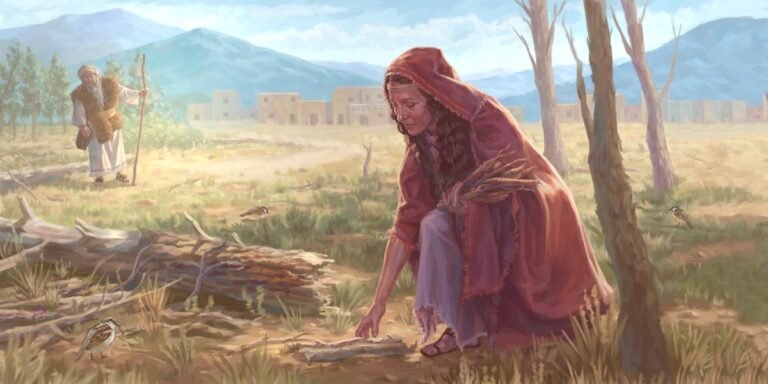
Naomi was returning to Israel from Moab — widowed, bereaved of both her sons, stripped of everything. She told her two daughters-in-law to return to their own families and find new husbands. One of them, Orpah, kissed her mother-in-law and left. The other — Ruth — refused to go.
Ruth’s declaration is one of the most beloved in all of Scripture — but it is easy to read it through the lens of sentiment and miss what it actually cost. Ruth was a Moabite woman choosing to attach herself to a bitter, widowed, returning Israelite woman with no property and no prospects. She was leaving her own country, her family, her cultural identity, her language, and her gods. She would be a foreigner in Israel — subject to the social vulnerabilities of the ancient Near East’s most vulnerable category: a foreign widow.
She knew all of this. And she went. Not because there was obvious advantage. Not because she was promised a happy ending. But because love and loyalty had made the choice before her head could finish calculating the cost. Her courage was the courage of committed love — the kind that does not require conditions, guarantees, or a good outcome to remain true to itself.
And the story that followed was extraordinary. Ruth gleaned in the fields of Boaz, a relative of Naomi. Boaz showed her extraordinary kindness. He eventually married her. She became the great-grandmother of King David — and a named ancestor in the genealogy of Jesus Christ (Matthew 1:5). The woman who gave up everything became a pillar in the lineage of everything.
Every story of human courage in the Bible points forward to this one. In the garden of Gethsemane, on the night before the crucifixion, Jesus fell on His face and prayed. Luke records that “his sweat was like drops of blood falling to the ground” (Luke 22:44) — a rare medical condition called haematohidrosis, which occurs under extreme emotional and physical distress. The One who had calmed storms with a word was in anguish.
Jesus prayed this three times. The repetition tells us everything: this was not a casual prayer. He was genuinely grappling with what lay ahead — not just the physical agony of crucifixion, but the infinitely more terrible weight of becoming sin, of being separated from the Father, of bearing the full accumulated guilt of every human being who had ever lived or would ever live. He asked if there was another way. There was not. And He chose it anyway.
“Yet not as I will, but as you will.” Seven words. The most courageous sentence ever spoken by a human voice. Not the absence of human feeling — the text shows He was in agony. Not the absence of desire — He clearly longed for another way. But the deliberate, conscious, freely-chosen subordination of His will to the Father’s — for the sake of what the Father was accomplishing through the thing He was dreading.
He walked out of the garden to Judas, to the arrest, to the trials, to the cross — not as a victim but as a volunteer. No one takes my life from me, He had said. I lay it down of my own accord (John 10:18). The cross was the most powerful and courageous act in the history of the universe — and it began with a prayer in a dark garden.
All Nine Stories at a Glance
A reference grid for the specific courage each story offers
God-confidence over self-confidence. Measure the giant against God, not against yourself.
Courage of sustained obedience. Keep marching even when the strategy makes no military sense.
Courage to speak up. Prepare, pray, and walk through the door. “If I perish, I perish.”
Courage of faithful habits. “Just as he had done before” — daily faithfulness sustained in crisis.
“Even if he does not.” Courage not conditioned on a promised outcome.
Courage to rest and recover. God feeds you first and commissions you second.
Courage of midnight worship. Praise God before the circumstances change.
Courage of love. The loyal road costs more and leads further than the easy road.
“Not my will but yours.” Surrender as the deepest and most powerful form of courage.
What the Bible Says to the Person Who Has None of This
All nine of these stories can produce one of two responses: inspiration — or discouragement. If you read David and feel motivated, wonderful. But if you read these stories and feel the gap between their courage and yours — like the soldiers in Saul’s army who could not move while a teenager ran past them — this section is for you.
The Bible does not primarily call you to be courageous through willpower. It calls you to be strong in the Lord — and in the strength of His power (Ephesians 6:10). The heroes of these nine stories were not intrinsically braver than everyone around them. They were connected to something — or Someone — that gave them access to a strength that was not native to them.
The God of David, of Joshua, of Esther, of Daniel, of the three men in the furnace, of Elijah under the tree, of Paul and Silas in chains, of Ruth in the fields, and of Jesus in the garden — is the same God you have access to right now. The courage you need for your situation is not generated inside yourself. It is received from the One who has never run from anything, never been out of options, and has never once lost a battle that He decided to fight.
You do not have to feel brave to take the next step. You have to trust the One who goes ahead of you into it. That is all these stories are, at their core: accounts of ordinary people who were afraid and who trusted anyway — and whose trust turned out to be well-placed.
Courage and strength go hand in hand with God’s healing — whether physical, emotional, or spiritual. Explore these powerful scriptures that speak directly to strength in hard seasons and healing in broken places.
📖 Read: Bible Verses About Strength and Healing →The Thread That Runs Through Every Story
What nine very different people in very different situations all discovered about courage
A shepherd boy. A general. A queen. An administrator. Three young men in an empire. An exhausted prophet. A missionary in chains. A widowed foreigner. The Son of God in a garden. Nine different people. Nine completely different situations. Nine completely different expressions of courage.
One thread connecting all of them: none of them were strong in themselves. All of them drew from a source outside themselves. All of them faced something they could not handle with what they had — and chose to trust the One who could handle it with what He had. And all of them discovered, in the acting, that the God they trusted was exactly who He said He was.
He still is. The God of the Valley of Elah is the God of whatever valley you are standing in today. He has not changed strategies. He has not run out of options. He has not been caught off-guard by your Goliath, your lions’ den, your furnace, your prison, your midnight, or your garden. And His instruction to you is the same as it was to Joshua — repeated, patient, firm, and specific:
“Be strong and courageous. Do not be afraid; do not be discouraged, for the Lord your God will be with you wherever you go.”
— Joshua 1:9 (NIV) — The word that has sent men and women into battle for three thousand years. It still holds.Which Story Did You Need Today? ⚔️
One of these nine stories was written for the exact situation you are in right now. Share this article with someone who needs the courage to take the next step — and tell us in the comments which story spoke to you most.
📖 Bible Stories About Strength and Courage — 9 Stories, Complete Narratives, Lessons for Today
David. Joshua. Esther. Daniel. Shadrach, Meshach & Abednego. Elijah. Paul & Silas. Ruth. Jesus. Nine people who were afraid — and trusted anyway. ⚔️