

A neighbour has been sick for several days, but nobody has visited. A woman has lost her husband and is finding it difficult to care for her family. Someone new comes to church and sits alone because they do not know anyone.
What would you do if you met one of these people?
Sometimes, showing kindness means giving someone food or money. At other times, it means listening, offering help, or treating a person with respect.
The Bible gives us many examples of people who showed kindness in different ways. Some helped strangers. Others cared for their families or stood up for people who could not protect themselves.
These Bible stories about kindness help us understand what it means to care for others.
As you read, you will meet Ruth, Boaz, David, Dorcas, and several other people whose actions made a difference in someone’s life.
You will also see how Jesus treated people who were sick, lonely, or in need.
The stories are easy to follow, and each one has something we can learn for our lives today.
What Does Kindness Mean in the Bible?
Kindness means treating people with care, patience, and respect.
It is more than smiling at someone or speaking politely. There are times when kindness requires us to notice that another person is struggling and offer help.
The Bible teaches that kindness should be part of a Christian’s life.
In Ephesians 4:32, Paul tells believers to be kind and compassionate to one another. He also calls them to forgive each other, just as God forgave them through Christ.
Galatians 5:22–23 includes kindness among the fruit of the Spirit.
This means kindness is not something Christians should show only when they are happy or when someone has treated them well.
We are called to show love even when it is not easy.
But kindness does not mean allowing people to mistreat us. It also does not mean that we must give everyone whatever they ask for.
True kindness seeks what is good for others. Sometimes, this means helping someone. At other times, it means speaking the truth or protecting a person from harm.
The following Bible stories show what kindness can look like in different situations.
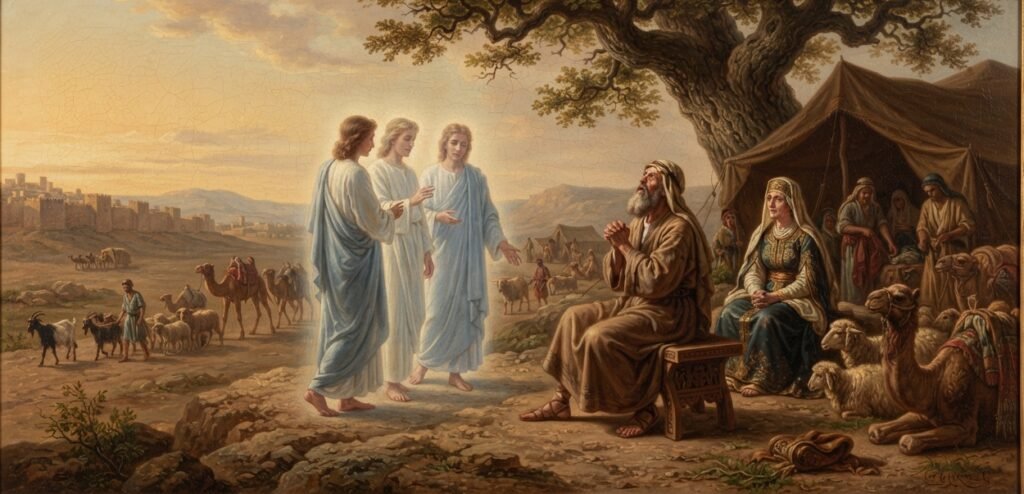
1. Abraham Welcomed Three Visitors Into His Home (Genesis 18:1–8)
One day, Abraham was sitting near the entrance of his tent when he saw three men standing nearby.
It was during the heat of the day.
When Abraham saw the visitors, he ran to meet them and bowed before them.
He asked them to stay for a while and rest under a tree.
He also offered to bring water so they could wash their feet.
But Abraham did more than that.
He hurried to Sarah and asked her to prepare bread. He then chose a calf and gave it to a servant to prepare.
When the food was ready, Abraham brought it to the visitors.
He stood nearby while they ate.
The visitors had not come to Abraham’s tent begging for food. Abraham saw them and offered to care for them.
This is what makes the story a good example of hospitality.
In Bible times, travellers often depended on the kindness of others for food, water, and a place to rest.
Abraham understood that his visitors needed care.
We may not live in tents or welcome travellers in the same way today, but there are still many ways to show hospitality.
A new family may move into your neighbourhood. Someone may visit your church for the first time. A friend may travel a long distance to see you.
You do not have to prepare an expensive meal before showing kindness.
Offering a glass of water, a seat, or a warm welcome can help someone feel comfortable.
Abraham’s story reminds us that kindness can begin when we notice another person’s needs.
Sometimes, the person we help may not even ask.
2. Ruth Refused to Leave Naomi Alone (Ruth 1:1–22)
Naomi had experienced great sorrow.
She left Bethlehem with her husband and two sons because there was a famine in the land.
They went to live in Moab.
While they were there, Naomi’s husband died.
Her two sons later married Moabite women named Ruth and Orpah.
After some years, both sons also died.
Naomi was left without her husband or children.
When she heard that there was food again in Bethlehem, she decided to return home.
Her daughters-in-law began the journey with her.
But Naomi told them to go back to their own families.
She believed they would have a better chance of finding new husbands and building new lives in Moab.
Orpah kissed Naomi goodbye and returned home.
Ruth made a different choice.
She told Naomi that she would go wherever Naomi went. She also chose to live among Naomi’s people and worship Naomi’s God.
Ruth did not want to leave her mother-in-law to face the journey alone.
She followed Naomi to Bethlehem.
When they arrived, the two women had to find a way to survive.
Ruth went into the fields to gather leftover grain so they could have food.
Her kindness was not limited to words. She stayed with Naomi and helped provide for her.
There is something important we can learn from this.
People who are grieving often need more than someone telling them to be strong.
They may need help preparing food, caring for children, or completing simple household tasks.
Sometimes, they need someone who will sit with them and listen.
Ruth could not bring Naomi’s husband and sons back to life.
But she could stay close to her and help her through a painful time.
If someone you know has lost a loved one, you may find more helpful advice in Christian Grief Support: What to Say and What Not to Say to Someone Mourning.
Ruth’s story reminds us that kindness can mean being present when another person feels alone.
3. Boaz Treated Ruth With Respect When She Needed Help
Bible passage: Ruth 2:1–23
When Ruth arrived in Bethlehem with Naomi, she needed a way to find food.
She decided to go into the fields and gather grain left behind by the workers.
This practice was allowed under God’s law. Farmers were instructed to leave some grain for poor people, foreigners, widows, and others who needed help.
Ruth went to work in a field belonging to a man named Boaz.
When Boaz arrived, he noticed her.
He asked his workers who she was.
They told him that Ruth was the Moabite woman who had returned with Naomi.
Boaz had already heard about the kindness Ruth had shown her mother-in-law.
He spoke to Ruth and encouraged her to remain in his fields.
He told his workers not to trouble her.
He also made sure she could drink water when she was thirsty.
At mealtime, Boaz invited Ruth to eat with the workers.
Later, he instructed his men to leave extra grain for her to gather.
Boaz had more than Ruth. He owned land, had workers, and was in a position to help.
Ruth was a foreign widow trying to find food.
Boaz did not use his position to make her feel small.
He treated her with respect and made sure she could work safely.
This is an important lesson for people who have authority over others.
If you own a business, how do you treat workers who depend on their wages?
If you lead a group in church, do you welcome people who have little money or influence?
If someone is new in your neighbourhood, do you make them feel like an outsider?
Boaz’s kindness was not only about giving Ruth food.
He also gave her a safe place to work and treated her with dignity.
When we help people, we should be careful not to embarrass them or make them feel worthless.
Someone who needs help still deserves respect.
4. Pharaoh’s Daughter Saved Baby Moses (Exodus 2:1–10)
There was a time when the Israelites were living under cruel treatment in Egypt.
Pharaoh had ordered that Hebrew baby boys should be killed.
During this dangerous time, a Hebrew woman gave birth to a son.
She hid him for three months.
When she could no longer keep him hidden, she made a basket and covered it so water would not enter.
She placed the baby inside and left the basket among the reeds by the River Nile.
The child’s sister stood at a distance to see what would happen.
Then Pharaoh’s daughter came down to the river to bathe.
She noticed the basket and sent a servant to bring it to her.
When she opened it, she saw a crying baby.
She felt sorry for him.
Pharaoh’s daughter knew that the child was one of the Hebrew babies.
But she did not order him to be killed.
Instead, she showed compassion.
The baby’s sister came forward and asked whether she should find a Hebrew woman to nurse the child.
Pharaoh’s daughter agreed.
The girl brought the baby’s own mother, who was then able to care for him.
Later, when the child was older, his mother brought him to Pharaoh’s daughter.
She adopted him and named him Moses.
This story is remarkable because the person who protected Moses belonged to Pharaoh’s own household.
Her father had ordered the killing of Hebrew boys, yet she chose to save one.
She saw a baby who needed protection.
Sometimes, kindness means refusing to follow a cruel example.
A person may grow up in a family or community where certain people are treated badly.
But that does not mean they must continue treating people the same way.
We can choose to act differently.
Pharaoh’s daughter reminds us that a person’s background should not stop us from showing compassion.
When someone is in danger or needs protection, their life matters.
5. David Remembered Jonathan and Helped Mephibosheth
Bible passage: 2 Samuel 9:1–13
David and Jonathan had been close friends.
Jonathan was the son of King Saul, and he had shown great love and loyalty to David.
They had made promises to remain faithful to one another and their families.
Many years later, Jonathan was dead, and David had become king.
One day, David asked whether anyone from Saul’s family was still alive.
He wanted to show kindness to that person because of Jonathan.
A servant named Ziba told David about Mephibosheth, Jonathan’s son.
Mephibosheth had injured both feet when he was a child and was unable to walk normally.
David sent for him.
When Mephibosheth came before the king, he bowed down.
David told him not to be afraid.
He promised to show him kindness for the sake of Jonathan.
David then returned to Mephibosheth the land that had belonged to Saul.
He also told him that he would eat regularly at the king’s table.
Mephibosheth was surprised by David’s kindness.
He had not come to the palace asking the king to give him land or a place at his table.
David had remembered his promise and decided to act.
Think about how easily people can forget those who once helped them.
Someone may support us during a difficult season. But when our lives improve, we become busy and stop checking on them.
David remembered Jonathan even after his friend had died.
His kindness reached Jonathan’s son.
There is a lesson here about keeping promises and remembering people.
If someone helped you when you had little, do not forget them when things become better.
And when you make a promise to help another person, try to keep it.
David’s action also helps us think about mercy and generosity.
For more biblical accounts of undeserved favour and mercy, read Great Examples of Grace in the Bible.
6. The Good Samaritan Helped a Man Others Passed By
Bible passage: Luke 10:25–37
One day, a man who was an expert in the law asked Jesus what he needed to do to inherit eternal life.
Jesus asked him what the law said.
The man answered that he should love God and love his neighbour as himself.
Then he asked Jesus another question.
Who was his neighbour?
Jesus answered by telling a parable.
A man was travelling from Jerusalem to Jericho when robbers attacked him.
They took his belongings, beat him, and left him badly injured beside the road.
After some time, a priest came along.
He saw the injured man but passed by on the other side.
Later, a Levite came to the same place.
He also saw the man and passed by.
Then a Samaritan came along the road.
When he saw the injured man, he felt compassion for him.
He went to him, treated his wounds with oil and wine, and bandaged them.
He placed the man on his own animal and took him to an inn.
There, he cared for him.
The following day, the Samaritan gave money to the innkeeper and asked him to look after the injured man.
He promised to pay any extra cost when he returned.
At the end of the story, Jesus asked which of the three travellers had acted like a neighbour to the injured man.
The expert in the law answered that it was the one who had shown mercy.
Jesus told him to go and do likewise.
The Good Samaritan is one of the best-known Bible stories about kindness.
But we should remember why Jesus told it.
He wanted the man asking the question to understand what it means to love a neighbour.
The Samaritan did not ask whether the injured man belonged to his family or community.
The story does not tell us the injured man’s background.
What mattered was that someone was suffering and needed help.
In everyday life, we may meet people who are different from us.
They may speak another language, come from another town, or attend a different church.
We may not agree with everything they believe.
But we can still treat them with kindness.
There is also another lesson in the story.
The Samaritan did not only feel sorry for the injured man.
He stopped and helped.
Kind feelings are good, but there are times when people need practical support.
You may not be able to provide everything someone needs. If there is danger, you should seek help rather than putting yourself at risk.
But when you can safely help someone, do not overlook their need simply because they are a stranger.
The Good Samaritan teaches us to see people as neighbours who deserve mercy and care.
7. Jesus Touched a Man With Leprosy
Bible passage: Mark 1:40–45
A man with leprosy came to Jesus and knelt before Him.
He asked Jesus to make him clean if He was willing.
Leprosy was a term used in Bible times for several serious skin conditions.
Under the law given to Israel, people with certain skin diseases had to live apart from others until they were declared clean.
This could make life very difficult.
The man who came to Jesus needed more than ordinary help.
His condition affected his health and his place among other people.
Jesus reached out and touched him.
He told the man that He was willing and commanded him to be clean.
The man was healed.
Jesus then instructed him to show himself to the priest and make the offering required by Moses.
He also told him not to spread the news about what had happened.
But the man went out and told many people.
As a result, Jesus could no longer enter towns openly in the same way.
What stands out in this story is the way Jesus responded to the man.
He did not turn away from him.
He touched him.
Jesus showed care to someone whose condition had separated him from ordinary life.
We cannot heal people the way Jesus did in this account.
But we can learn from His compassion.
Some people live with illnesses or disabilities that make them feel isolated.
Others are avoided because people do not understand their condition.
It is important to treat them with respect.
We should listen, offer suitable help, and avoid saying things that make them feel ashamed.
We should also follow sensible health precautions when an illness can spread.
Kindness does not require ignoring medical advice.
It means remembering that a person who is sick is still a person who deserves love and dignity.
8. Dorcas Was Remembered for Helping Widows
Bible passage: Acts 9:36–42
In the town of Joppa, there was a follower of Jesus named Tabitha.
Her Greek name was Dorcas.
The Bible says she was known for doing good and helping people in need.
But one day, Dorcas became sick and died.
The believers washed her body and placed it in an upstairs room.
When they heard that Peter was nearby, they sent two men to ask him to come quickly.
Peter went with them.
When he arrived, the widows gathered around him.
They were crying.
They showed Peter the clothes Dorcas had made while she was alive.
These women had not forgotten her kindness.
They remembered the help she gave them.
Peter sent everyone out of the room, knelt down, and prayed.
He then turned toward the body and told Tabitha to get up.
She opened her eyes and sat up.
Peter helped her stand and presented her alive to the believers.
The news spread through Joppa, and many people believed in the Lord.
Dorcas’ story includes a great miracle, but there is something else we should notice.
Before Peter raised her from the dead, the widows were already showing how much her life had meant to them.
They had clothes she made.
These were simple things that had helped them.
Dorcas did not need to be a queen or a famous leader to make a difference.
She used what she had to care for people.
Not everyone has enough money to give large gifts.
But kindness does not always require money.
Someone who knows how to sew may repair clothes for a family in need.
A person who can cook may prepare food for someone who is sick.
Another person may help an elderly neighbour clean their home.
Dorcas reminds us that ordinary skills can become a way of showing love.
The work may seem small, but it can mean a great deal to the person receiving the help.
9. Cornelius Gave to the Poor and Welcomed Peter
Bible passage: Acts 10:1–48
Cornelius was a Roman centurion living in Caesarea.
A centurion was an officer in the Roman army.
Although Cornelius was a Gentile, he respected God.
The Bible says that he prayed regularly and gave generously to people in need.
One afternoon, an angel appeared to him in a vision.
The angel told him that his prayers and gifts to the poor had come before God.
He was then instructed to send men to Joppa to bring Peter.
Cornelius obeyed.
While his men were travelling, Peter received a vision of his own.
Through what followed, Peter came to understand that he should not treat Gentiles as people who were unfit to hear God’s message.
When Peter arrived at Cornelius’ home, Cornelius had gathered his relatives and close friends.
They were ready to listen.
Peter spoke about Jesus Christ, His death, and His resurrection.
While Peter was speaking, the Holy Spirit came upon those who heard the message.
The believers with Peter were amazed that Gentiles had also received the Holy Spirit.
Cornelius’ story is about more than giving to the poor.
It is also about God’s welcome of people from different nations through Jesus Christ.
Still, Cornelius’ generosity is an important part of how the Bible introduces him.
He prayed and helped people in need.
Both were part of his life.
Sometimes, we separate worship from the way we treat others.
We may attend church and pray regularly but pay little attention to someone who is hungry or struggling.
Cornelius reminds us that care for others has a place in a life devoted to God.
Giving does not have to be public.
You do not need to tell everyone whenever you help someone.
A quiet act of generosity can still meet a real need.
Cornelius also welcomed Peter into his home, even though they came from different backgrounds.
His story invites us to think about how we treat people outside our usual circle of friends.
Do we welcome them?
Are we willing to listen?
Or do we judge them before we know them?
Kindness can help us overcome barriers that keep people apart.
Bible passages: Acts 2:42–47; Acts 4:32–35
After Jesus rose from the dead and returned to heaven, His followers began sharing the gospel in Jerusalem.
Many people believed and became part of the growing church.
The believers spent time learning from the apostles, praying, and sharing meals.
They also cared for one another’s needs.
Acts 2 tells us that some sold property and possessions and shared with those who needed help.
Later, Acts 4 explains that the believers were united in heart and mind.
People who owned land or houses sometimes sold them and brought the money to the apostles.
The money was then distributed to those who were in need.
The purpose was to make sure that members of the community who lacked basic things received help.
These believers understood that following Jesus should affect the way they cared for one another.
But this does not mean that Christians today must sell everything they own.
In Acts 5:4, Peter made it clear that Ananias had control over his property and the money from its sale.
The giving described in the early church was not a command for every believer to give away everything.
The important lesson is that the believers noticed needs within their community and took action.
Think about what this could mean in a church today.
Perhaps an elderly member cannot afford transport to a hospital appointment.
A family may be struggling to buy food after losing a source of income.
A student may need books for school.
Not everyone will have enough money to solve these problems.
But when people work together, they may be able to help.
Some can give money. Others can provide food, offer transport, share useful skills, or help someone find work.
We should also handle shared money honestly and carefully so that help reaches the people who need it.
The early church gives us a picture of believers caring for one another through practical actions.
Their kindness was not only spoken about during worship.
It became part of the way they lived together.
What These Bible Stories Teach Us About Showing Kindness
The people in these stories did not all show kindness in the same way.
Abraham offered food and rest to visitors.
Ruth stayed with Naomi when she was grieving.
Boaz gave Ruth a safe place to gather food.
Pharaoh’s daughter protected a baby whose life was in danger.
David remembered his promise to Jonathan and cared for Jonathan’s son.
The Samaritan stopped to help an injured stranger.
Jesus treated a sick man with compassion.
Dorcas made clothes for people in need.
Cornelius gave generously, while the early Christians shared resources with those who had less.
One lesson runs through all these accounts: kindness should affect what we do, not only what we say.
You do not need to be wealthy or important before you can be kind.
Sometimes, the help someone needs is something you already have.
It may be your time, your attention, or your willingness to listen.
There is also a lesson about respect.
A person who needs help should not be treated as less important than the person giving it.
Boaz did not embarrass Ruth because she was poor. Jesus did not turn away from the sick man. The Samaritan did not leave the injured traveller beside the road.
Kindness becomes more meaningful when it protects another person’s dignity.
Does Being Kind Mean You Must Always Say Yes?
No.
The Bible teaches kindness, but it also teaches wisdom.
There may be times when someone asks you for money you cannot afford to give.
A person may repeatedly lie to you or try to make you feel guilty because you cannot meet every request.
You may also be dealing with someone who is abusive or dangerous.
Being kind does not mean you must allow those things to continue.
You can say no without being cruel.
You can speak respectfully while setting a firm boundary.
You can forgive someone without immediately trusting them with the same responsibility again.
Sometimes, a person needs food or a safe place to stay. At other times, they need honest advice, medical care, or help from someone trained to handle their problem.
It is important to understand what kind of help is truly needed.
For example, if someone is sick, kindness may mean helping them reach a doctor rather than telling them to pray without seeking treatment.
If a person is being abused, kindness may mean helping them find safety instead of telling them to remain in danger.
Jesus showed compassion, but He also taught people the truth.
We should try to do the same.
Kindness is not about pleasing everyone.
It is about loving people and seeking what is good for them.
Simple Ways to Show Kindness Every Day
You do not have to wait for a big opportunity before putting these lessons into practice.
Look at the people around you.
Is there someone who has been ill and needs a visit or a phone call?
Do you know a family that is going through a difficult time?
Has someone helped you in the past whom you have not spoken to for a long time?
You may be able to show kindness through a simple action.
At home, you can listen to a family member who needs to talk. You can help with work without waiting to be asked.
At church, you can welcome someone who is new. You can sit beside a person who usually sits alone.
At work, you can treat people fairly, speak respectfully, and avoid embarrassing someone who makes a mistake.
In your neighbourhood, you can check on an elderly person, help someone carry a heavy load, or support a family that needs assistance.
If you have more than you need, consider sharing with someone who has less.
And if you cannot give money, remember Dorcas.
She used her skills to help others.
There are many ways to be useful.
You can also pray for people who are facing trouble. Prayer is important, but when you are able to meet a practical need, do not ignore the opportunity.
James 2:15–17 warns against offering kind words to someone who lacks food or clothing without helping to meet their needs.
That passage challenges us to make our concern for others real.
For a wider look at putting God’s Word into practice, you can read 20 Bible Lessons for Adults That Still Hold Up in Real Life.
Which Bible Story About Kindness Should You Read First?
If you are not sure where to begin, choose a story that relates to a situation in your life.
| If you want to learn about… | Read this story | Bible passage |
|---|---|---|
| Welcoming visitors | Abraham and his three visitors | Genesis 18:1–8 |
| Caring for a grieving family member | Ruth and Naomi | Ruth 1–2 |
| Helping someone with respect | Boaz and Ruth | Ruth 2:1–23 |
| Protecting someone in danger | Pharaoh’s daughter and Moses | Exodus 2:1–10 |
| Keeping promises and remembering others | David and Mephibosheth | 2 Samuel 9 |
| Helping a stranger | The Good Samaritan | Luke 10:25–37 |
| Treating sick people with compassion | Jesus and the man with leprosy | Mark 1:40–45 |
| Using your skills to help others | Dorcas and the widows | Acts 9:36–42 |
| Giving generously | Cornelius | Acts 10:1–8 |
| Caring for people in your community | The early church | Acts 2:42–47; 4:32–35 |
You can read the full passage in your Bible and think about what happened.
Who needed help?
Who noticed the need?
What did the person do?
These questions can help you understand each story without making it complicated.
Then think about whether there is someone you can help in a similar way.
A Final Thought on Kindness
The Bible shows us that kindness can change what someone experiences during a difficult time.
Naomi had lost her family, but Ruth stayed with her.
Mephibosheth had not asked David for help, yet David remembered him.
A badly injured traveller was left beside the road, but the Samaritan stopped.
The widows in Joppa remembered Dorcas because she had cared for them.
These people were helped in different ways, but each act of kindness mattered.
We may never face the same situations, yet we meet people who need care almost every day.
Some need food. Others need protection, comfort, friendship, or a person who will listen.
As Christians, we are called to love others, not only in words but also through our actions.
You may not be able to help everyone.
But you can begin with someone whose need you already know.
Who can you show kindness to today?