Home should be a place where you can rest, spend time with your family, and feel safe.
But sometimes, life at home becomes difficult.
You may worry about your children’s safety. Someone in your family may be sick. There may be arguments between people who once lived peacefully together. Or perhaps you are afraid because of something happening around your neighbourhood.
During these times, it is natural to ask God for protection.
The Bible has many passages that speak about God’s care, His power over evil, and the peace He gives His people.
These Bible verses to protect your home from evil can help you pray for your household and place your trust in God.
You will find Scriptures about protection, resisting evil, overcoming fear, and building a peaceful Christian home. Each passage comes with a simple explanation so you can understand what it teaches.
Before we begin, there is something important to remember.
Reading a Bible verse or saying a prayer does not mean that nothing bad can ever happen to your family. Faithful Christians can still experience illness, loss, accidents, and other troubles.
The Bible encourages us to trust God in those situations. It does not teach us to ignore danger or stop taking care of ourselves.
You can pray for your home while also doing what is wise to keep everyone safe.
All Scripture quotations in this article are from the King James Version (KJV).
What Does the Bible Say About Protecting Your Home From Evil?
The Bible teaches that God is a refuge for those who trust Him.
Psalm 46:1 describes Him as our refuge and strength. Jesus taught His followers to pray for deliverance from evil in Matthew 6:13. And in Ephesians 6:10–18, Paul encouraged believers to stand firm against the devil’s schemes.
These passages remind us that Christians can seek God’s help when they face evil, fear, or temptation.
But the Bible also teaches that we should live wisely.
We should be honest, care for one another, turn away from sin, and treat our families with love.
A peaceful Christian home is not built through prayer alone while everyone continues hurting one another.
Prayer should lead us closer to God and help us live according to His Word.
If you want to pray for your household, begin by asking God to guide your heart and the way you treat the people living with you.
Then use the following Scriptures to guide your prayers.
Five Bible Verses About God’s Protection Over Your Home
Let begin with these five verses to pray for God protection over your home.

1. Psalm 91:1–2 — God Is Our Refuge
“He that dwelleth in the secret place of the most High shall abide under the shadow of the Almighty. I will say of the LORD, He is my refuge and my fortress: my God; in him will I trust.”
Psalm 91 is one of the best-known Bible passages about God’s protection.
It describes God as a safe place for people who trust Him.
The words refuge and fortress speak about shelter and safety. A refuge is somewhere a person can go when danger comes. A fortress is a strong place built to withstand attacks.
The writer uses these words to show his confidence in God.
If you are worried about your home or family, you can read this psalm and remember that you are welcome to seek God’s help.
But Psalm 91 should be read carefully.
It also says in verse 15 that God will be with His people in trouble. That tells us the psalm is not teaching that trouble will never come.
In Matthew 4:5–7, the devil even quoted part of Psalm 91 while tempting Jesus to put Himself in danger. Jesus refused to test God in that way.
We should follow His example.
Trusting God does not mean creating danger or ignoring sensible precautions.
When you pray with Psalm 91, ask God to protect your family, strengthen your faith, and help you act wisely.
You can pray:
Heavenly Father, You are my refuge and my strength. Please watch over my home and everyone who lives here. Help us trust You when we are afraid. Give us wisdom to recognize danger and make good choices. In Jesus’ name, Amen.
2. Psalm 121:7–8 — Ask God to Watch Over Your Family
“The LORD shall preserve thee from all evil: he shall preserve thy soul. The LORD shall preserve thy going out and thy coming in from this time forth, and even for evermore.”
Psalm 121 is a song about looking to God for help.
The writer begins by saying that his help comes from the Lord, who made heaven and earth.
Later, he speaks about God’s care when His people go out and return.
This is a meaningful passage to read when family members leave home for work, school, or a journey.
Parents often worry when their children are away.
A husband or wife may feel concerned when their spouse travels to another town.
You can bring those concerns to God in prayer.
Ask Him to guide your loved ones, protect them from harm, and help them return safely.
At the same time, remind them to follow road safety rules, avoid dangerous places, and tell someone where they are going when necessary.
Prayer and responsible behaviour can go together.
If someone in your family is travelling, NameClust also has 13 Prayers for Protection and Safe Travel for You and Your Family.
3. Psalm 46:1 — God Is Present in Times of Trouble
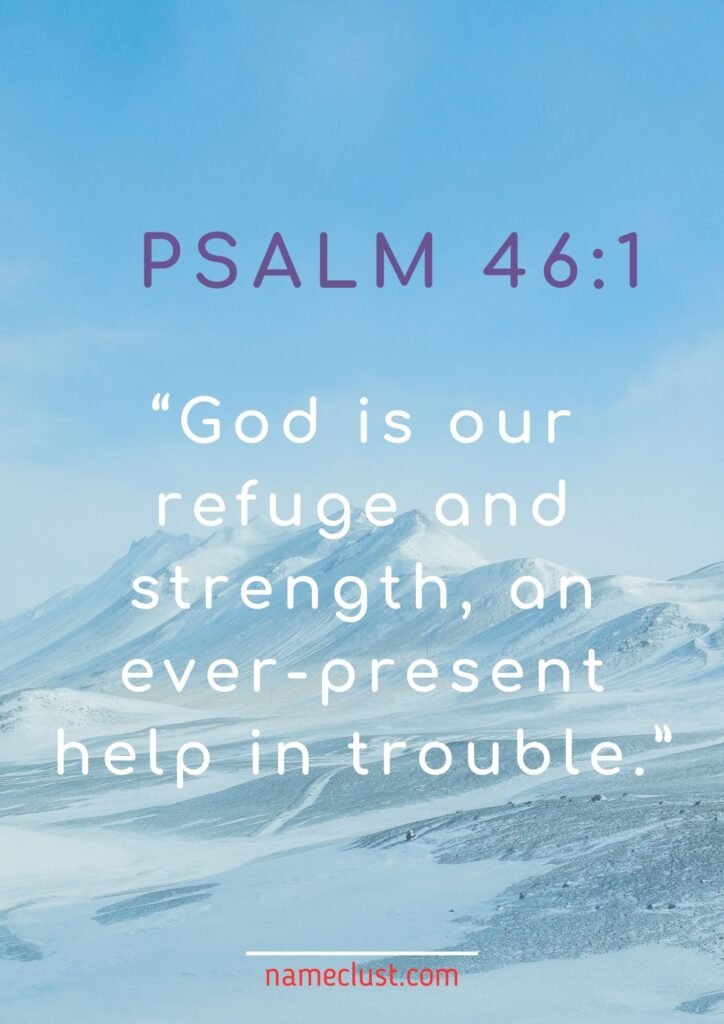
Some Bible verses encourage us because they are short and easy to remember.
Psalm 46:1 is one of them.
Notice that the verse does not say God’s people will never have trouble.
It describes Him as a help in trouble.
There may be days when your family faces something unexpected.
You could receive worrying news from a doctor. Your household may be struggling financially. There may be a problem that no one knows how to solve.
During such times, you can pray for strength and direction.
You can also ask trusted people for practical support.
Sometimes, the help you need may include medical care, financial advice, or assistance from family and friends.
Trusting God should not stop you from receiving suitable help.
Psalm 46 reminds us that we can turn to God even when we do not know what will happen next.
4. Psalm 27:1 — Do Not Let Fear Control Your Life
“The LORD is my light and my salvation; whom shall I fear? the LORD is the strength of my life; of whom shall I be afraid?”
David wrote Psalm 27 while speaking about enemies and danger.
He had reasons to be afraid, yet he expressed confidence in God.
Fear can affect the way we live.
A person who has experienced a burglary may struggle to feel safe at home.
Another person may become worried after hearing about crime in the neighbourhood.
If something frightening has happened, it is understandable to feel afraid.
You do not need to pretend that you are not worried.
You can speak honestly to God about what happened.
Ask Him to help you think clearly and take the right steps to protect yourself.
If your home has been threatened, contact the proper authorities or seek a safer place when needed.
Psalm 27 can encourage you while you deal with the situation.
It reminds us to look to God for strength instead of allowing fear to decide everything we do.
5. Proverbs 18:10 — Find Strength in the Lord

In ancient times, people sometimes fled into strong towers when enemies attacked.
A tower could provide shelter because of its height and strong walls.
Proverbs uses this picture to explain the safety found in the Lord.
The verse does not mean that saying God’s name will work like a secret password against danger.
It points us toward trusting Him.
When you feel weak or afraid, you can call on God in prayer.
You can ask Him for courage, protection, and wisdom.
And when you have a difficult decision to make about your family’s safety, do not act without thinking.
Take time to understand the situation.
God’s Word encourages faith, but it also teaches wisdom.
Five Scriptures for Praying Against Evil and Spiritual Temptation
The Bible speaks about the devil, temptation, and spiritual opposition.
Christians should take these teachings seriously without becoming afraid of everything around them.
A nightmare does not automatically mean that an evil spirit has entered your home. Family arguments and illnesses can have many causes.
The following passages help us understand how believers are called to respond to evil.

6. Matthew 6:13 — Jesus Taught Us to Pray for Deliverance From Evil
“And lead us not into temptation, but deliver us from evil: For thine is the kingdom, and the power, and the glory, for ever. Amen.”
This verse comes from the Lord’s Prayer.
Jesus taught His followers to pray for their daily needs, forgiveness, and help against temptation and evil.
That makes Matthew 6:13 especially helpful when praying for your household.
You can ask God to protect your family from people who intend harm.
You can also pray that everyone in your home will have the strength to resist dishonesty, cruelty, and other wrong actions.
Think about the things that sometimes damage family relationships.
Angry words can hurt people. Lies can destroy trust. Dishonest behaviour can cause serious problems.
We need God’s help not only against harm from outside but also in dealing with our own wrong choices.
This verse reminds us to seek His guidance each day.
7. John 17:15 — Jesus Prayed for His Followers’ Protection
“I pray not that thou shouldest take them out of the world, but that thou shouldest keep them from the evil.”
In John 17, Jesus prayed to His Father shortly before His arrest.
He prayed for His disciples, who would continue living in a world where they could face trouble and opposition.
Jesus did not ask that they be removed from the world.
He asked that they be kept from evil.
Later in the chapter, Jesus also prayed for those who would believe in Him through the disciples’ message.
This passage helps us understand Christian protection in a deeper way.
Jesus knew that His followers would face difficult situations.
His prayer was not that they would never experience hardship.
He wanted them to remain faithful to God.
When praying for your family, you can ask God to help each person remain strong in faith and avoid harmful influences.
Pray that your children will learn what is right.
Ask for wisdom to guide them without making them afraid of the world.
And remember to support your prayers with patient teaching, good communication, and a loving example.
8. 2 Thessalonians 3:3 — The Lord Is Faithful
“But the Lord is faithful, who shall stablish you, and keep you from evil.”
Paul wrote these words to Christians in Thessalonica.
In the surrounding passage, he asked them to pray for him and his companions because they were facing opposition.
Then he reminded the believers of the Lord’s faithfulness.
The old English word stablish means to make firm or strengthen.
This verse is therefore about depending on God to strengthen and guard His people.
When you are worried about spiritual temptation or opposition, remember that your faith does not depend only on your own strength.
You can ask God to help you remain faithful.
For example, a family member may be struggling with a harmful habit. You can pray for that person while encouraging them to seek the support they need.
Someone who is being pressured to do wrong may need wise advice and a trusted person to talk to.
God’s faithfulness gives us a reason to pray and continue doing what is right.
9. James 4:7 — Submit to God and Resist the Devil
“Submit yourselves therefore to God. Resist the devil, and he will flee from you.”
James gives two instructions in this verse.
First, submit to God.
Second, resist the devil.
These two instructions belong together.
To submit to God means to accept His authority and seek to live according to His Word.
Resisting the devil means refusing what leads us away from God.
The surrounding verses speak about humility, repentance, and drawing near to God.
That is an important part of the passage.
It is not simply telling Christians to shout at evil until it disappears.
Imagine someone who regularly lies to their family but continues asking God to protect the home from evil.
That person also needs to take responsibility for their actions.
A household that wants to honour God should make room for truth, repentance, and forgiveness.
If you want to apply James 4:7 to your home, begin with your own actions.
Ask God to show you anything you need to change.
Then seek His help to turn away from it.
10. Ephesians 6:10–11 — Put on the Armour of God
“Finally, my brethren, be strong in the Lord, and in the power of his might. Put on the whole armour of God, that ye may be able to stand against the wiles of the devil.”
Paul uses the picture of a soldier’s armour to explain how believers should stand firm.
When we continue reading Ephesians 6, we find that the armour represents truth, righteousness, faith, salvation, the message of peace, and God’s Word.
Paul also tells believers to pray.
These are not physical weapons.
He is teaching Christians to depend on God and remain faithful when facing spiritual opposition.
The passage has a lesson for our homes.
If we want our families to grow in faith, we should make time for Scripture, prayer, honesty, and love.
It is not enough to place a Bible on a table while ignoring what it teaches.
We need to put God’s Word into practice.
Children can learn through the way adults speak and behave.
When parents admit their mistakes, keep promises, and treat others with respect, they are showing something important about Christian living.
Our homes should be places where the teaching of Christ can be seen in everyday actions.
Five Bible Verses for Peace and Freedom From Fear at Home
A person can be physically safe and still feel worried.
You may be lying in bed while thinking about money, family problems, or something that happened earlier in the day.
These verses speak about rest, prayer, courage, and the peace Christ gives.
11. Psalm 4:8 — Ask God for Peaceful Sleep
“I will both lay me down in peace, and sleep: for thou, LORD, only makest me dwell in safety.”
David speaks about lying down to sleep while trusting in God.
Night can be difficult when the mind is full of worries.
When the house becomes quiet, you may begin thinking about problems you could not solve during the day.
Perhaps you are concerned about your children or worried about what tomorrow will bring.
Psalm 4:8 gives you words to bring before God.
Before going to bed, you can thank Him for the day and ask Him to give you rest.
You can also take care of simple things that help make your home safe, such as checking that doors are secured and electrical appliances are being used safely.
After doing what you reasonably can, try to rest rather than spending the whole night worrying about every possible danger.
This verse is a prayer of trust, not a promise that Christians will never experience poor sleep.
If you have ongoing sleep problems, it is wise to seek medical advice.
12. Isaiah 26:3 — Keep Your Mind Focused on God

Isaiah 26 is a song of trust in God.
Verse 3 speaks about the peace given to a person whose mind remains focused on Him.
When you are worried, your thoughts may move from one problem to another.
You may imagine things going wrong even before there is any sign that they will.
Isaiah encourages us to turn our thoughts toward God.
This does not mean you must stop thinking about your responsibilities.
It means you can face them while remembering that you are not relying only on yourself.
If something needs your attention, deal with it as wisely as you can.
Then bring the matter to God in prayer.
If you are facing severe or lasting anxiety, prayer can be part of your support, but it should not replace appropriate treatment.
You can find further prayers and guidance in 21 Prayers for Depression and Anxiety When You Need God’s Comfort.
13. Philippians 4:6–7 — Bring Your Worries to God
“Be careful for nothing; but in every thing by prayer and supplication with thanksgiving let your requests be made known unto God. And the peace of God, which passeth all understanding, shall keep your hearts and minds through Christ Jesus.”
In this passage, the expression be careful for nothing means that we should not be controlled by worry.
Paul encourages believers to bring their requests to God with thanksgiving.
He then speaks about God’s peace guarding their hearts and minds through Christ.
If your family is going through a difficult time, you can use this passage to guide a simple prayer.
You do not need to hide your concerns.
Tell God what is happening.
If you are worried about school fees, work, rent, or a family member’s health, mention those needs.
You can also thank Him for the help you have already received.
The passage does not promise that every problem will disappear as soon as you pray.
It reminds us that we can bring our worries before God instead of carrying them alone.
14. 2 Timothy 1:7 — Ask God for Courage and a Sound Mind
“For God hath not given us the spirit of fear; but of power, and of love, and of a sound mind.”
Paul wrote these words while encouraging Timothy to remain faithful in his ministry.
Timothy needed courage because serving Christ could bring opposition and hardship.
Paul reminded him of God’s strength, love, and the ability to think and act wisely.
This verse is often read when people are afraid.
It can be helpful, but we should not use it to shame someone for feeling fear.
Fear is a human response to danger or uncertainty.
A person who is frightened does not automatically lack faith.
What matters is how we respond.
Ask God to give you a steady mind.
If you need to make a decision, avoid acting in panic.
Find out what is happening, speak to someone you trust, and take the steps that are necessary.
God’s Word encourages courage and wisdom, not careless behaviour.
15. John 14:27 — Jesus Gives His People Peace
“Peace I leave with you, my peace I give unto you: not as the world giveth, give I unto you. Let not your heart be troubled, neither let it be afraid.”
Jesus spoke these words to His disciples before His death.
They were about to face a difficult time.
Jesus knew they would feel troubled when He was arrested and crucified.
He spoke to them about the peace He would give.
This was not a promise that their lives would become free from problems.
It was a comfort for people who would soon face great sorrow.
Your household may also experience days of sadness and uncertainty.
There may be times when someone loses a job or a loved one.
You can read John 14:27 during those moments and ask Jesus to help your family remain close to Him.
Sometimes, a peaceful home is not one where everyone is smiling.
It is one where people can speak honestly about their troubles and receive love and support.
Five Bible Verses for Building a Godly and Peaceful Home
Protection is not only about keeping danger outside.
The way people treat one another inside the home also matters.
A house can have strong doors and good security, yet the people living there may still be hurting because of constant insults, dishonesty, or abuse.
These final five passages remind us that a Christian household should seek God’s guidance in everyday life.
16. Joshua 24:15 — Choose to Serve the Lord in Your Home
“…but as for me and my house, we will serve the LORD.”
Joshua spoke these words to the Israelites when he called them to choose whom they would serve.
He reminded them of what God had done for them and urged them to turn away from other gods.
Joshua made his own decision clear.
He and his household would serve the Lord.
This verse is often displayed on walls or near the entrance of Christian homes.
There is nothing wrong with using it as a reminder.
But placing the words on a wall is not the same as living by them.
Serving God should affect the way we treat one another.
It should encourage honesty, kindness, patience, and respect.
Parents can help their children learn Scripture. Family members can pray together when they have time.
They can also show their faith through small acts of love.
Joshua 24:15 is about choosing to serve God, not a promise that displaying a verse will prevent every danger.
17. Psalm 127:1 — Let God Guide the Way You Build Your Home
“Except the LORD build the house, they labour in vain that build it: except the LORD keep the city, the watchman waketh but in vain.”
Psalm 127 reminds us that human effort is not enough without God’s help.
It speaks about building a house and watching over a city.
The watchman had an important responsibility.
He had to remain alert and look out for danger.
But the psalm teaches that even careful human effort cannot replace dependence on God.
This gives us a balanced way to think about home protection.
Pray for your household.
Ask God to guide your choices.
But do not neglect the responsibilities you have.
Repair unsafe wiring. Take fire risks seriously. Secure your home as best you can. Pay attention to threats and seek help when something is wrong.
These actions do not show a lack of faith.
They are ways of caring for the lives entrusted to you.
We can depend on God while also doing our part.
18. Colossians 3:13–15 — Make Room for Forgiveness and Love
“Forbearing one another, and forgiving one another, if any man have a quarrel against any: even as Christ forgave you, so also do ye.”
Paul goes on to tell believers to put on love and allow God’s peace to rule in their hearts.
These instructions were written to the church, but they are also valuable in family relationships.
People who live together will sometimes disagree.
A child may disobey a parent.
A husband and wife may have different opinions about money.
Brothers and sisters may become angry with each other.
During these moments, the way we speak matters.
It is easy to make a small disagreement worse through insults or harsh words.
Colossians encourages patience, forgiveness, and love.
If you have hurt someone in your family, admit what you did and ask for forgiveness.
If someone has hurt you, consider what healing and reconciliation may require.
Remember that forgiveness does not mean ignoring abuse or returning to an unsafe situation.
Love should never be used as an excuse to allow harm to continue.
19. Ephesians 4:31–32 — Do Not Allow Bitterness to Control Your Household
“Let all bitterness, and wrath, and anger, and clamour, and evil speaking, be put away from you, with all malice: and be ye kind one to another, tenderhearted, forgiving one another, even as God for Christ’s sake hath forgiven you.”
This passage speaks directly about the way Christians should treat each other.
Paul warns against bitterness, uncontrolled anger, and harmful speech.
He then calls believers to kindness and forgiveness.
Sometimes, a home becomes difficult because people have stopped listening to one another.
Small problems grow into serious arguments.
A person may carry an old hurt for many years.
The Bible calls us to turn away from bitterness and treat one another with care.
If you have been speaking harshly to someone in your home, begin by changing your words.
Listen before responding.
Avoid using insults when you disagree.
When you are wrong, apologise.
And if anger has led to threats or violence, seek appropriate help and safety. Prayer should never be used to pressure someone to remain in danger.
God’s Word calls us to love others through our actions.
20. 1 Peter 5:8–9 — Remain Watchful and Firm in Faith
“Be sober, be vigilant; because your adversary the devil, as a roaring lion, walketh about, seeking whom he may devour: whom resist stedfast in the faith…”
Peter wrote to Christians who were facing suffering.
He encouraged them to remain watchful and firm in their faith.
Being watchful does not mean becoming suspicious of every person or treating every strange event as a spiritual attack.
The instruction is to remain spiritually alert.
Christians should be careful about temptations that can harm their lives and relationships.
We should avoid dishonest behaviour, harmful influences, and choices that lead us away from God.
We should also continue learning from Scripture and praying.
Peter reminds his readers that other believers were facing suffering too.
This is important.
When your family is going through trouble, you do not have to face it alone.
Seek encouragement from trusted Christians who can pray with you and offer wise support.
And remember that spiritual strength grows through a steady relationship with God, not through fear of what might happen.
Can Bible Verses Automatically Protect a House From Evil?
The Bible encourages Christians to pray for protection, but it does not teach that simply repeating certain verses will automatically prevent accidents, illness, theft, or suffering.
God’s Word is not a magical object.
Reading Psalm 91 or placing a Bible beside your bed does not mean that nothing bad can happen.
What matters is trusting God and responding to His Word.
In Matthew 4:6–7, the devil used words from Psalm 91 to tempt Jesus to jump from the temple.
Jesus refused.
He answered that we must not put God to the test.
This helps us understand why Scripture should not be used carelessly.
If you pray for safety, you should still take sensible precautions.
If a family member is ill, seek medical care.
If someone is threatening you, find safety and ask for help.
If there is a serious problem in your household, do not assume that the only possible explanation is an evil spirit.
There may be practical causes that need attention.
Prayer is a way of seeking God, not a replacement for responsible action.
How to Pray Over Your Home Using Bible Verses
You do not need a special prayer book or complicated words before you can ask God to bless your household.
You can pray alone, with your spouse, or together as a family.
Choose one Bible passage that relates to what you are facing.
If you are worried about safety, read Psalm 121.
If you are afraid, read Psalm 27 or John 14:27.
If there is conflict in your household, read Ephesians 4:31–32.
Then speak to God in your own words.
You can mention the people living with you and ask Him to guide and protect them.
For example, you might say:
Lord, thank You for my family. Please protect us from harm and help us live in peace. Teach us to speak kindly, forgive one another, and make wise decisions. Keep our hearts close to You. In Jesus’ name, Amen.
You can also thank God for the home you have, even if it is small or you are renting it.
God does not hear prayers only from people who own houses.
And you do not need to pray at a particular hour for your prayer to matter.
Some people prefer to pray in the morning. Others pray before going to bed.
Choose a time when you can pray sincerely.
If you are observing a period of fasting, you may also find 21 Prayer Points During Fasting With Bible Verses helpful.
Do You Need Anointing Oil to Pray for Your Home?
Some Christian churches use anointing oil when praying for people or blessing homes.
Other churches do not follow this practice.
The Bible mentions anointing with oil in passages such as James 5:14, where church elders are called to pray for someone who is sick.
However, the Bible does not give Christians a general instruction that they must put oil on every door or window to keep evil away.
Oil should not be treated as a magical substance.
If your church uses anointing oil during prayer, the focus should remain on God rather than on the oil itself.
You can also pray for your household without using oil.
The important thing is to seek God sincerely and live according to His Word.
A Prayer to Protect Your Home and Family From Evil
Heavenly Father,
Thank You for the home You have provided for us.
Thank You for every member of my family and for the gift of another day.
Lord, I place our household before You.
Please protect us from people who wish to harm us, from accidents, and from dangers we may not see.
Help us to remain alert and make wise decisions about our safety.
Where there is fear, please give us courage.
Where there is anger, teach us patience.
Where there has been dishonesty, help us tell the truth and make things right.
Father, keep our hearts from evil and give us strength to resist temptation.
Help our children grow in wisdom and learn what is right.
Guide the adults in this home so that our words and actions set a good example.
If anyone among us is sick, please bring comfort and guide us toward the care they need.
If someone is facing trouble, help us stand together and offer support.
Protect our family relationships from bitterness, hatred, and cruelty.
Teach us to forgive one another without ignoring serious harm.
Let our home be a place where people are treated with love and respect.
Lord Jesus, thank You for the peace You give Your people.
Even when life is uncertain, help us keep trusting You.
Watch over us when we go out and when we return.
May our lives honour You, both inside our home and wherever we go.
In Jesus’ name, Amen.
What Should You Do When You Still Feel Afraid at Home?
There may be times when you have prayed but still feel afraid.
Do not condemn yourself because the feeling has not disappeared.
Fear can continue after a frightening experience.
If something happened in your home, give yourself time to recover.
You can speak with someone you trust about what you are feeling.
If your fear is connected to a real danger, take action to make yourself safe.
If you keep having nightmares, sleeping poorly, or feeling frightened even when there is no clear danger, it may help to speak with a healthcare professional.
These experiences do not automatically mean your home is under spiritual attack.
You can continue praying while receiving the support you need.
If you are unsure what to do, ask God for wisdom and seek trustworthy advice.
NameClust’s article on Bible Verses About Wisdom and Knowledge may also help you think about making careful decisions.
Final Thoughts on Bible Verses to Protect Your Home From Evil
Every Christian family needs God’s help.
Some days bring peace and joy. Other days bring difficult news, worries, and problems we did not expect.
The Bible encourages us to bring these things before God.
Psalm 91 reminds us to trust Him as our refuge. Matthew 6 teaches us to pray for deliverance from evil. Ephesians 6 calls us to stand firm in faith.
Other passages remind us that peace at home also grows through love, honesty, forgiveness, and wise decisions.
You do not have to read all twenty verses in one day.
Begin with the passage that speaks to your present need.
Read it carefully. Think about its meaning. Then pray with an honest heart.
As you ask God to protect your household, continue doing what you can to care for everyone who lives there.
May your home be a place where God’s Word is respected, love is practised, and every family member is treated with care.